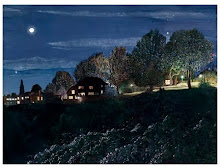
It seems like there's a word for everything if you just keep searching for it. Recently I wrote about the low cement embankment at the Viewpoint. Well, I stopped by the Viewpoint this morning and got to wondering whether I'd used the right word for what I called the "embankment." At first there was nobody else there. But then two women came walking along. I asked them, "What would you call this cement strip here?" "Footings," one offered, without hesitation. I'm not sure that word is appropriate, regardless of whether it's in the singular or plural. But I think embankment may be way off, too. If you go to the Viewpoint and you can come up with a better word, please let me know.
As I was leaving, I noticed that a few leaves on the Sentinel--the Bigleaf Maple that grows up from just underneath the edge--have already turned yellow. And the samaras (the "maple keys" containing the seeds) have now more or less turned brown. Time marches on.
Monday, August 31, 2009

Sunday, August 30, 2009
Dragonflies
This evening, while sitting at the Viewpoint, I noticed dragonflies in the air, flying not only above, but also below, the level of the edge.
Friday, August 28, 2009
9, 15, 38 and 8; Sandstone, Not Concrete
I just went to the Viewpoint again. If I remember correctly, I counted nine hawthorns, fifteen steps leading up to the sculpture, thirty-eight steps around it, and eight benches. Two of the eight benches are side by side, but they're essentially separate. Some of the benches have backs; some don't. I'll have to make a note of how many there are of each kind the next time I go to the Viewpoint.
It now seems to me that the stones I wrote about earlier today, which I said were made of concrete, or cement, are actually pieces of sandstone. I asked a woman passing by, and she concurred.
It began to drizzle as I was leaving.
It now seems to me that the stones I wrote about earlier today, which I said were made of concrete, or cement, are actually pieces of sandstone. I asked a woman passing by, and she concurred.
It began to drizzle as I was leaving.
Paul D. Natkin, Painter of Memory
I'm always looking for the shape and color of what's been forgotten. I'm drawn to hidden corners and dust swept under the rug.
Twenty-three Stones
There are twenty-three stones at the Viewpoint. I counted them this morning. This includes the big rock at the head of the trail going down to the ravine. It also includes a mostly submerged rock nearby and a large, almost completely submerged stone near the south entrance and another stone close to the latter which lies flat on the ground and is partially submerged. This doesn't include the three concrete bollards that stand at the entrances: one at the north entrance and two at the south entrance. (There are two possibilities for entry at the south end, so two bollards were required to keep anyone from entering the park in a car, I suppose.) Another kind of stone I'm not including in this tally of twenty-three is type of stone used to support the lamp fixtures. There are three of these stones, if I remember correctly. They're basically blocks of concrete. Their size differs from lamp to lamp. As I counted, I found myself wondering what the difference really is between a rock and a stone. There are many things I might call either "rock" or "stone," but it seems to me that if something is actually made of cement, or concrete, it shouldn't be called a rock. I think of a "rock" as something formed by the forces of nature. We often speak of "headstones" in reference to the markers in cemeteries. Many of these are made of marble, granite or other kinds of rock, but if I'm not mistaken, some are made of cement, or concrete, and still we call them "stones." Many of the "stones" at the Viewpoint are, in fact, pieces of cement or concrete. Maybe later I'll give more details about their composition. I could check my photos, so that I don't have to go to the Viewpoint a second time today, but it's hard to tell much about a stone's composition from a photo, unless the photographer has made a point of focusing on the stone. I do have lots of close-up photographs of plants and animals that live in the park, but none of rocks, as I recall.
Next time I go to the Viewpoint I'll count the hawthorns that line the side of the park adjacent to the arterial. These are some of the last hawthorns on the hill. One was recently lost.
Next time I go to the Viewpoint I'll count the hawthorns that line the side of the park adjacent to the arterial. These are some of the last hawthorns on the hill. One was recently lost.
Thursday, August 27, 2009
The Three Sections of Lawn
The lawn in the park can be divided into three sections: the part on the side of the path closer to the street; the part that's on the same level as the path, on the side of the path closer to the edge (and the view); and the part that's below the level of the path, on the side of the path closer to the edge (and view). The two levels of lawn on the side of the path closer to the edge are made distinct by a low embankment that runs more or less the distance of the park. This embankment takes several turns. It has a total of seven corners. Six of these corners are concave; one is convex.
Today I noticed that there's something else of which there are seven in the park: the concrete steps leading from the cement path to the laurel tree, in its enclosure. (It seems to me I had a better word for the wooden structure surrounding the laurel. What was it?) The seven steps are all rectangular and all the same size.
Today I saw a woman taking a photo of a couple standing under the laurel tree. The three people were speaking an Asian language that I didn't recognize. I stood still for a moment as the woman took the photo. Reserve, or maybe a certain shyness, prevented me from asking what language these people were speaking, although I was curious to know. As I've mentioned, there's an endless stream of photographers at the Viewpoint, especially on sunny days. Many of them do come from foreign countries: Japan, Russia, China, India, Korea, Germany and any number of other places.
Today I noticed that there's something else of which there are seven in the park: the concrete steps leading from the cement path to the laurel tree, in its enclosure. (It seems to me I had a better word for the wooden structure surrounding the laurel. What was it?) The seven steps are all rectangular and all the same size.
Today I saw a woman taking a photo of a couple standing under the laurel tree. The three people were speaking an Asian language that I didn't recognize. I stood still for a moment as the woman took the photo. Reserve, or maybe a certain shyness, prevented me from asking what language these people were speaking, although I was curious to know. As I've mentioned, there's an endless stream of photographers at the Viewpoint, especially on sunny days. Many of them do come from foreign countries: Japan, Russia, China, India, Korea, Germany and any number of other places.
Wednesday, August 26, 2009
The Shortcut
Last night I looked at the edge in the dark; today I looked at it in the day. The question is which way I can remember it best. When it's dark, the edge is clearly delineated from the space beyond it. The edge is illuminated; the space is not. But in the daytime, I can see more about what's going on with the edge as it curves around the hillside than I can at night. For instance, roughly six feet to the southwest of the Sentinel, there's a stretch of bare earth going down from the edge to the trail below. This stretch of bare earth is an unofficial trail, formed by the clambering feet of all the people who have chosen to take a shortcut from the park to the official trail, instead of walking to the end of the park, where the rock marks the official beginning of the trail. I remember at least once or twice taking photos of someone scrambling up this unofficial trail--or tearing down it. There are two large exposed tree roots that form "stairs" on this shortcut, as well as a third that sticks out at a funny angle at the bottom. At night you don't see the shortcut at all, but it's an important marker of distance in the curve as it wraps around the hill. One more thing I should mention: the greatest degree of curvature occurs on the other side of the Sentinel, in the direction of the adjacent street. I've taken a lot of photos to document this. It's a simple, humble curve--like a simple, humble song.
Subscribe to:
Posts (Atom)